
UFFIZI GALLERY HISTORY – OVER 400 YEARS OF ART & CULTURE
The Uffizi Gallery: A Medici Masterpiece
The Uffizi Gallery is a legacy of the influential Italian Medici family. It was built as part of a larger project to create a space for the city’s administrative offices under Cosimo I in 1560. His son Francesco I established the museum in 1581 to display the extensive Medici family art collection. The last Medici heiress, Anna Maria Luisa, transferred the collection to the Tuscan state in 1737 under the “Family Pact,” which required it to remain in Florence.
Today, the Uffizi Gallery stands as one of the world’s most renowned art galleries, exhibiting an impressive collection of Renaissance masterpieces, Western artworks, prints, and various sculptures from ancient times to the early modern period.

From offices to art gallery
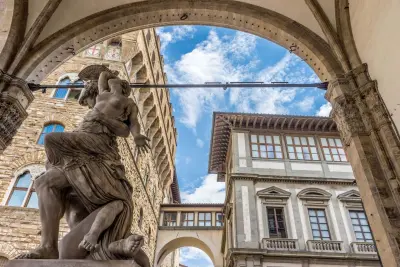
When Cosimo I de’ Medici decided in 1560 to build the Uffizi Palace, his initial focus was not on art. His intention was to design a large building to accommodate Florence’s administrative offices, known as “uffizi” (Italian for “offices”). The state archive was also located there. The building was designed to show the status and prestige of the Medici family. Cosimo selected Giorgio Vasari to design the new building in a U shape with a central courtyard surrounded by two main wings and a corridor linking Uffizi to the Pitti Palace, which the Medici family used as their residence. Bernardo Buontalenti completed the building after Vasari’s death in 1574. The Uffizi Palace, which covers an area of about 13,000 square meters, was completed in 1580. It included open galleries, classical columns, and harmonious proportions typical of Mannerist architecture.

Transformation into museum
Francesco I de’ Medici, Cosimo’s son and the new Grand Duke of Tuscany, turned the Uffizi Palace into a museum in 1581 to display the Medici family’s prized art collection and make it accessible to the public. The Grand Duke was aware of the importance of art in preserving their family’s legacy, and his intention also included further strengthening their already significant political influence. Francesco I continued the Renaissance trend of opening private collections to the public. Members of the Medici family valued and appreciated art and were often associated with various famous artists and intellectuals.

Medici family: Art guardians
A private gallery that Francesco I established was initially located on the top floor of the east wing of the Uffizi. The gallery included art objects in the private family collection, including Roman sculptures. The main point of this private museum was the octagonal room called Tribuna or the Tribune. Completed by Bernardo Buontalenti in 1584, it represents the four elements and is decorated with marble, stones, and shells. As the collections of the Medici family continuously increased in size, more sections were added to display the art objects.
For many years, 45 to 50 rooms were used to present paintings from the 13th to 18th century.

Anna Maria Luisa: A gift to Florence
After the last family member, Anna Maria Luisa de Medici, passed away, she donated the art collections to the Tuscan State in 1737 with specific instructions that the art should stay in Florence and be shared with the public. Sixteen years later, Uffizi was made open to public viewing and still contains many works commissioned and collected by the Medici. The Gallery was opened to the public in 1769 by Grand Duke Peter Leopold.
From Botticelli to Michelangelo
The Medici family commissioned and collected works from many renowned artists, resulting in the Uffizi Gallery housing one of the world’s most important art collections, especially of Italian Renaissance masterpieces. It includes iconic paintings by artists like Sandro Botticelli, Leonardo da Vinci, Michelangelo, and Raphael. The Gallery also displays an extensive collection of self-portraits, classical sculptures from ancient Rome and Greece, and art by Northern European artists like Albrecht Dürer and Jan van Eyck.

Prints and Drawings
In the mid-17th century, Cardinal Leopoldo de’ Medici added a section for print and drawings. The collection includes over 177,000 valuable drawings and prints and is located on the first floor in a space that was once used as a theater.
The Library
The Uffizi Library was established in the 18th century and opened in 1747. It was created to keep a valuable collection of books donated by Antonio Magliabechi, the librarian for the Medici grand dukes. The library is decorated with beautiful frescoes and intricate details and serves as a research center for scholars and art historians.
The Post Office
In 1866, The Reali Poste (Royal Post Office) opened in the Uffizi building on the ground floor behind the Loggia dei Lanzi. The post office remained active until 1917, after which the space was used mainly as an exhibition area.
19th Century changes
The art collections were initially organized by type, separating the paintings from scientific objects, which were relocated to a new museum called La Specola, mainly focused on Zoology and Natural History. In the 19th century, many Renaissance statues were transferred to the National Museum of Bargello to create more space, and some Etruscan pieces were moved to the Archaeological Museum.

Nuovi Uffizi
Over the years, the Gallery was renovated a few times and extended to accommodate its increasing art collection. The “Nuovi Uffizi” (New Uffizi) project, which started in 1989, is part of this ongoing expansion, focusing on modernizing and adding more exhibition space and facilities to improve the visitor experience and security while preserving historical architecture.
An exhibition space was expanded to allow visitors to see the items that were usually not displayed due to a lack of space.
Preserving the Uffizi: Attacks and Activism
The Uffizi Gallery has faced threats to its artworks, including a fatal 1993 Mafia car bomb that damaged the palace, killed five people, and destroyed five pieces of art in the Niobe Room. In 2022 and 2024, climate activists glued themselves to the glass protecting Botticelli’s paintings to protest fossil fuel use and government inaction, but the artworks were not damaged. Since then, the gallery has further strengthened its security measures and reinforced protections around valuable pieces.
Popular art destination
As a significant site of Renaissance art and history, the Uffizi Gallery is central to the cultural heritage of Florence and Italy. The Gallery is recognized as one of the most important art museums in the world, with around 2.4 million visitors in 2023. Its world-class collection of Renaissance paintings and masterpieces by artists like Michelangelo, Leonardo da Vinci, and Botticelli continues to attract people from all over the world.
Interested in exploring the artistic heritage of Uffizi Gallery?

Priority access
Uffizi Gallery Small-Group Tour
Join us for a small-group tour of the Uffizi Gallery with priority access. Experience the art in one of the oldest museums in the world and learn interesting stories behind some of the world's most iconic masterpieces. Explore the beautiful corridors of the palace, which display the extensive collection of Renaissance art, including Botticelli's famous Birth of Venus and Primavera, Annunciation by Leonardo da Vinci, and Medusa by Caravaggio. After your tour, relax at the cafeteria on the Uffizi Gallery's terrace, where you can enjoy refreshments and stunning city views.

Customized itinerary
Uffizi Gallery Private Tour
Experience the Uffizi Gallery like a VIP with a personalized tour! Skip the long lines and enjoy private attention as you explore one of the world’s most valuable art collections from the 12th to the 17th century. View masterpieces by Raphael, Michelangelo, Da Vinci, Caravaggio, and Titian, including Botticelli's iconic The Birth of Venus. Discover the interesting stories behind the artworks and their creators, and learn about the history of this ancient museum. Feel free to ask questions, focus on the highlights, and make the most of your visit without wasting time wandering around!